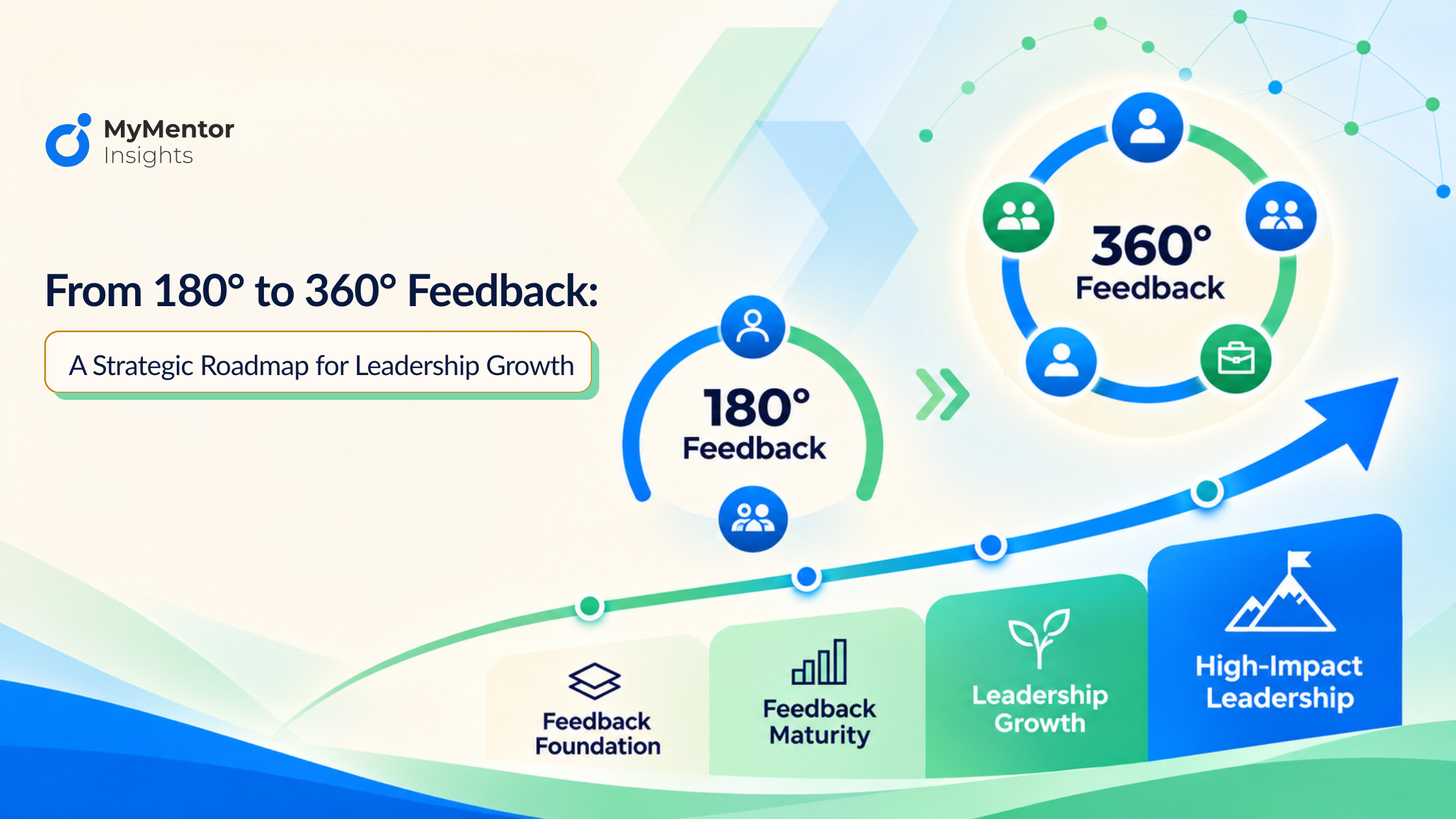
Is your organization’s feedback process keeping pace with its growth? When teams are small, direct conversations between managers and employees can provide the clarity needed to improve performance. But as organizations expand, employees collaborate across departments, managers oversee larger teams, and leadership responsibilities become more complex.
This is where a 360 degree feedback tool adds value. By combining manager feedback with perspectives from peers, direct reports, and self-assessments, organizations can uncover leadership blind spots and build more effective development strategies.
Both 180-degree and 360 degree feedback tools play important roles in organizational growth. Rather than treating them as competing approaches, organizations can use them together to strengthen employee development and leadership effectiveness.
Advancing your workplace culture is about choosing the right solution for your team’s current development stage. Transitioning from foundational 180-degree feedback assessments to an advanced 360-degree feedback tool allows you to continuously elevate manager effectiveness, strengthen team collaboration, and support leadership growth at every level.
What is a 360 Degree Feedback Tool?
A 360 degree feedback tool is specialized software designed to collect, aggregate, and analyze MyMentor Insights for an employee from a complete circle of workplace relationships. While 180-degree feedback typically focuses on a narrower set of perspectives, such as manager and employee assessments, 360 degree feedback expands the evaluation process to include multiple workplace relationships. The exact structure of a 180-degree review may vary between organizations.
- Direct Managers: Aligning core performance metrics, strategic execution, and output.
- Peers & Cross-Functional Colleagues: Highlighting cross-departmental collaboration, team synergy, and communication.
- Direct Reports: Measuring management style, delegation efficiency, and coaching impact.
- External Stakeholders or Clients (when applicable): Evaluating service delivery, customer experience, and key relationship management.
- Self-Assessments: Benchmarking an individual’s self-perception against collective peer feedback.
By automating survey distribution, protecting rater confidentiality through appropriate reporting thresholds, and organizing feedback into actionable insights, modern 360-degree feedback software helps organizations move beyond performance ratings toward meaningful professional development.
Why Evolve from 180 to 360 Feedback?
Both evaluation methodologies provide distinct strategic value across your organization. Integrating both tools into your talent management strategy offers complete coverage across every tier of workforce development:
- Leverages Targeted Focus & Comprehensive Scope
180-degree feedback provides a streamlined, agile environment ideal for fast-paced operational goal setting and role alignment. Expanding to 360-degree assessments adds valuable multi-rater context, illuminating daily work habits and peer collaboration across broader team structures. - Pairs Direct Manager Coaching with MyMentor Insights
A structured 180-degree evaluation can strengthen communication and trust between managers and employees when feedback is delivered constructively. Introducing 360-degree feedback builds on this foundation by incorporating additional perspectives, creating a more balanced understanding of workplace behaviors and development needs.
- Enhances Leadership Competency Frameworks
While 180s keep managers and employees closely focused on key task deliverables, 360s expand the evaluation lens toward broader leadership capabilities; such as emotional intelligence, strategic thinking, conflict resolution, and empowerment.This broader perspective also supports leadership competency assessment by helping organizations identify the behaviors that contribute to effective leadership across different roles. - Creates a Clear Career Growth Pathway
Using both tools enables HR teams to tailor their assessment approach to team needs: utilizing agile 180-degree evaluations for regular check-ins and deploying comprehensive 360 degree assessments for executive coaching, high-potential programs, and leadership succession planning.
How to Scale Your Feedback Process: A Phase-by-Phase Roadmap
Scaling your evaluation process allows organizations to maximize the benefits of both 180 and 360-degree assessment strategies across different growth phases.
Phase 1: Groundwork (The 180-Degree Stage)
The foundational stage of feedback maturity centers on manager employee feedback, role clarity, and structured alignment.
- Conduct regular manager-to-direct report and direct report-to-manager check-ins.
- Focus evaluations on job-specific key performance indicators (KPIs) and core role expectations.
- Utilize a user-friendly supervisor feedback tool to track performance metrics and build foundational psychological safety.
- Teach teams how to give and receive constructive criticism in a structured, supportive environment.
Phase 2: The Bridge (Preparing for MyMentor Insights)
As organization complexity grows, HR teams can easily expand their feedback options by introducing multi-rater frameworks alongside established 180-degree check-ins.
- Establish clear confidentiality guidelines and minimum rater-group thresholds to encourage honest responses and protect individual identities.
- Define a clear leadership competency assessment model across departments.
- Introduce 360 degree feedback software that simplifies survey distribution, reviewer management, and reporting.
- Communicate the goal of both feedback models clearly: driving continuous individual growth and professional development.
Phase 3: Targeted Rollout (Deploying the 360 Degree Feedback Tool)
Once structural prerequisites are established, launch your 360 degree feedback tool across key employee groups while maintaining 180s for quick alignment.
- Initiate pilot multi-rater reviews with executive leadership, department heads, and emerging manager pipelines.
- Collect comprehensive feedback from managers, direct reports, peers, and key internal stakeholders.
- Generate automated, visually intuitive report summaries that contrast self-assessment scores with peer benchmarks.
- Facilitate structured debrief sessions with certified internal HR coaches or external executive advisors.
A pilot program also gives HR teams an opportunity to evaluate survey completion rates, participant understanding, and the quality of feedback before expanding the process across the organization.
Phase 4: Continuous AI-Driven Integration (Peak Feedback Maturity)
The most valuable stage of feedback maturity is not simply adopting advanced technology. It is creating a consistent process in which feedback leads to development actions, behavioral improvements, and measurable progress. Organizations can combine continuous 180 check-ins and formal 360 reviews with AI-supported insights.
- Connect 180 and 360 assessment outputs directly to continuous action plans and personalized learning tracks.
- Use AI-supported analysis, with appropriate human oversight, to identify recurring themes in qualitative feedback and highlight development priorities.
- Combine formal 360 reviews with agile 180-degree pulse check-ins to monitor behavior change and goal progress over time.
- Evaluate success through development goal completion, changes in observable leadership behaviors, and follow-up feedback rather than survey participation alone.
How Does This Transition Work in Practice?
Consider a growing company with 150 employees. Initially, managers rely on regular one-on-one performance reviews to discuss goals, productivity, and individual responsibilities. As the organization expands, employees begin collaborating across multiple departments. Managers may have a clear understanding of individual performance but limited visibility into how employees communicate, support colleagues, or demonstrate leadership outside their immediate teams.
To address this gap, the HR team introduces a 360 degree feedback tool for department leaders. Feedback is collected from managers, peers, direct reports, and self-assessments. The results help identify differences between how leaders perceive their own behaviors and how others experience them. HR teams can then use these insights to develop personalized action plans, introduce targeted coaching, and monitor progress through follow-up conversations. This hypothetical example shows why moving from 180-degree to 360-degree feedback is not about replacing an existing assessment process. It is about expanding organizational insight as leadership responsibilities become more complex.
Feedback Maturity Matrix: 180 vs. 360 Overview
|
Dimension |
Stage 1: 180-Degree Feedback | Stage 2: 360-Degree Feedback |
|---|---|---|
|
Primary Evaluators |
Typically manager and employee, depending on the assessment design | Manager, Peers, Direct Reports, Self & Stakeholders |
| Core Strategic Value | Agile goal alignment, task clarity, and direct coaching | Broad leadership development, peer synergy, and high self-awareness |
| Perspective Range | Targeted, focused two-way perspective | Holistic, multi-rater 360-degree perspective |
| Primary Focus | Immediate performance outputs & role expectations | Broad leadership behavior, collaboration & core competencies |
| Tooling Required | Streamlined check-in platforms & supervisor feedback tools | Advanced 360 degree feedback tool with automated workflows |
| Best Suited For | Regular alignment, new hires, and direct manager coaching | Mid-level managers, executives, and cross-functional leadership teams |
Best Practices for Implementing Your Feedback Tools
To maximize the impact of both your 180-degree and 360 degree feedback tool initiatives, follow these core implementation principles:
- Align the Tool to the Objective
Use 180-degree tools for rapid role alignment, project debriefs, and ongoing 1-on-1 manager coaching. Reserve 360-degree assessments for structured leadership growth, cross-functional evaluations, and professional development milestones. - Ensure Absolute Rater Anonymity for Multi-Rater Reviews
When conducting 360-degree evaluations, establish minimum reporting thresholds for individual rater groups. Many organizations use thresholds of three to five respondents, although the appropriate requirement depends on the group, platform, and confidentiality policy. Explain how responses will be collected, combined, and presented so employees understand the protections and limitations of the process. - Train Employees on Delivering Constructive Inputs
Provide clear guidance across both tools on writing objective, actionable feedback. Ensure raters focus on observable workplace behaviors and growth opportunities. - Provide Guided Report Debriefs
Receiving feedback is most effective when paired with constructive support. Connect employees with HR representatives or trained managers to interpret assessment insights and construct clear development goals. - Track Action Plan Execution
Feedback delivers the greatest return when integrated into daily workflows. Establish 30, 60, and 90-day follow-up check-ins using 180-degree pulse check-ins to track progress on leadership development programs.
Turning Feedback Into Leadership Development With MyMentor Insights
Collecting feedback is only the beginning. The real opportunity lies in helping employees understand their results and translate those insights into meaningful behavioral change. MyMentor Insights supports this process through structured feedback assessments, interactive reporting, AI-supported coaching, and personalized development planning. Instead of leaving employees with static survey results, organizations can provide a more connected experience that encourages reflection and action.
By linking MyMentor Insights feedback with development planning, HR and L&D teams can identify leadership strengths, prioritize competency gaps, and provide individuals with guidance aligned to their growth needs. This creates a clearer connection between assessment insights, individual development goals, and ongoing leadership improvement.
Explore MyMentor Insights to learn how feedback can become a practical starting point for leadership development.
Key Considerations for a Smooth Rollout
- Clear Purpose Alignment: Ensure employees understand when and why each tool is being used – positioning 180s for regular manager coaching and 360s for holistic leadership growth.
- Optimized Survey Length: Keep surveys concise across both formats to avoid rater fatigue and ensure high-quality responses.
- Proactive Communication: Clearly explain the value of both feedback models before launch to build trust and enthusiasm across all departments.
- Action-Oriented Follow-Through: Pair survey results with ongoing developmental check-ins so employees feel fully supported in their growth.
- Measurable Development Outcomes: Track progress against clear leadership goals and observable behavioral improvements to evaluate the effectiveness of the feedback process.
Conclusion
Building a high-performing organization isn’t about choosing one tool over another; it’s about utilizing both 180-degree and 360-degree feedback frameworks at the right time. As teams expand and leadership responsibilities evolve, combining focused manager-employee conversations with broader MyMentor Insights can help organizations identify blind spots, strengthen leadership capabilities, and support continuous development.
However, feedback alone does not create better leaders. Sustainable improvement requires clear development priorities, constructive coaching, consistent follow-up, and opportunities to practice new behaviors.With a structured 360 degree feedback tool and an ongoing development process, organizations can turn employee perspectives into practical insights that support stronger leadership.
Discover how MyMentor Insights can help your organization connect feedback, self-awareness, and personalized leadership development.
Frequently Asked Questions
- What is a 360 degree feedback tool?
A 360 degree feedback tool is software that collects, synthesizes, and analyzes performance input from an employee’s full professional circle; including supervisors, peers, direct reports, and self-evaluations, to support well-rounded leadership development.
- When to transition from 180 to 360 feedback?
Organizations expand from 180 to 360 degree feedback tool as teams grow, cross-functional projects increase, or when leaders want to complement direct manager coaching with broader peer and direct-report perspectives. The ideal time depends on organizational readiness, employee trust, leadership development objectives, and the ability to act on feedback results.
- How do 180-degree and 360 degree feedback tools work together?
180-degree tools excel at providing fast, structured alignment between managers and direct reports for ongoing performance management, while 360 degree feedback tool offer comprehensive multi-rater insights ideal for leadership development and executive growth.Used together, these approaches help organizations combine regular performance conversations with broader leadership assessments and ongoing development tracking.