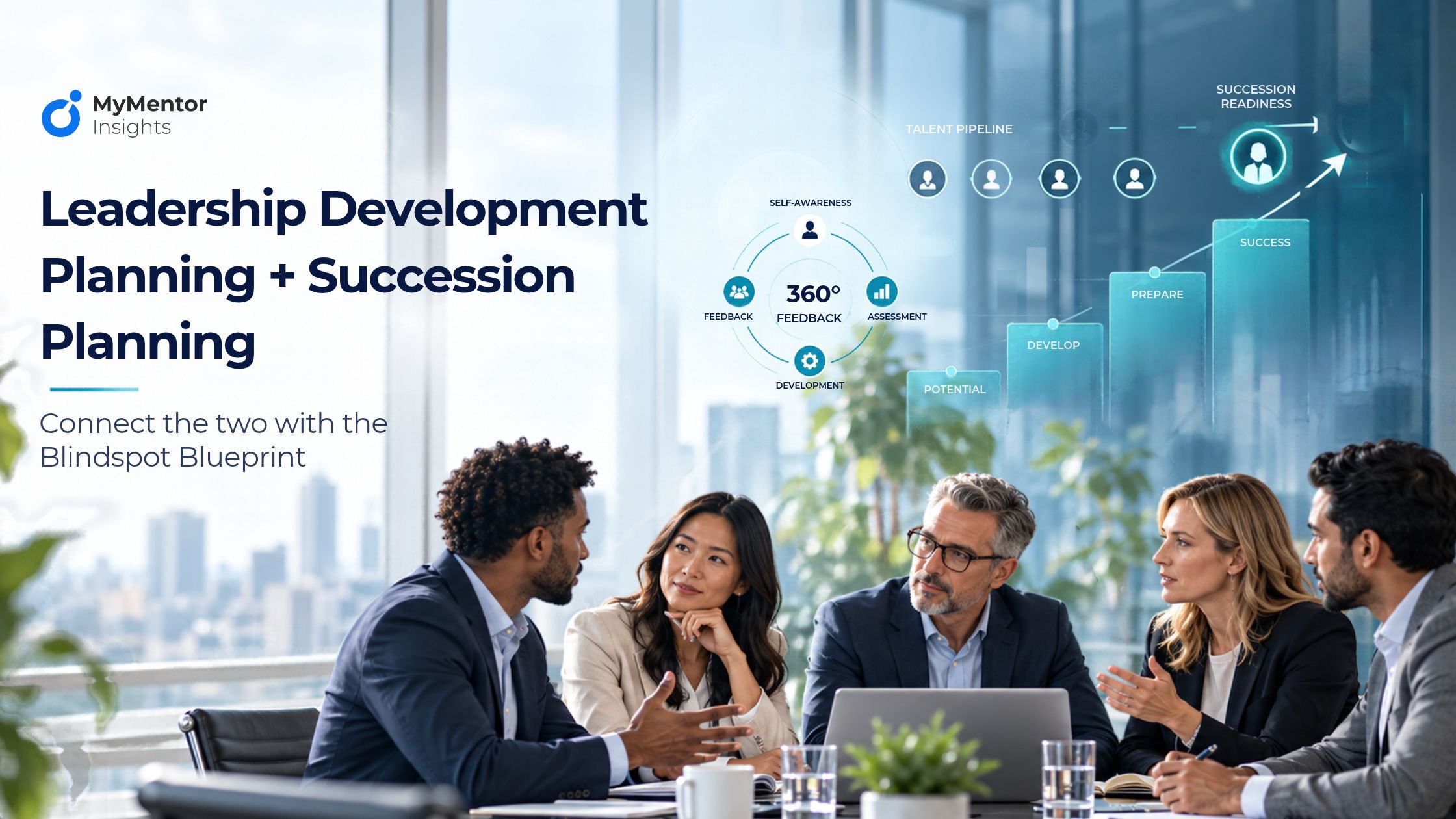
High-performing organizations often fall into a costly talent trap: promoting their top technical or functional performers into executive leadership positions based strictly on operational success. However, strong individual performance does not necessarily indicate readiness for a more complex leadership role.
According to Harvard Business Review, past performance alone cannot reliably determine whether an employee will excel in responsibilities they have not previously handled. This makes leadership potential assessment essential to effective succession planning.
When high-potential employees step into critical roles without self-awareness regarding their interpersonal or strategic gaps, organizations may experience turnover, cultural friction, and stalled strategic execution.
The missing link? Connecting your leadership development plan framework directly to your succession planning strategy.
By embedding data-driven multi-rater insights, what we call the Blindspot Blueprint, into your talent pipeline, you can identify development needs earlier and prepare potential executives through measurable behavioral improvements.
The Gap Between Leadership Development and Succession Planning
In many enterprise HR departments, leadership development and succession planning operate in siloed tracks:
- Leadership Development focuses on ongoing skill building, short-term training workshops, and broad managerial competencies.
- Succession Planning focuses on risk mitigation, future talent requirements, and filling potential vacancies.
When these two functions do not communicate, succession planning turns into a subjective guessing game. HR teams risk advancing candidates who look great on paper but harbor critical, unaddressed blind spots, such as poor delegation, defensive communication, or a lack of emotional intelligence.
To build a resilient talent pipeline, succession decisions must be informed by objective, multi-perspective behavioral data.
What Is the Blindspot Blueprint?
A blindspot in leadership occurs when a manager’s self-perception diverges significantly from how their peers, direct reports, and superiors perceive their behavior.
For instance, a candidate for an executive role may rate themselves high in “transparent communication,” while their direct reports rate them significantly lower. If promoted without addressing this disconnect, that leader may inadvertently erode psychological safety across their department.
The Blindspot Blueprint is a structured methodology that uses a multi-rater feedback mechanism to systematically expose these perceptional gaps, convert them into self-reflection opportunities, and anchor them into measurable, long-term action items.
The Center for Creative Leadership emphasizes that comparing self-ratings with feedback from colleagues can strengthen leadership self-awareness and help identify development priorities.
By integrating these insights into succession planning, organizations can evaluate not only who demonstrates leadership potential but also which skills require improvement before promotion.
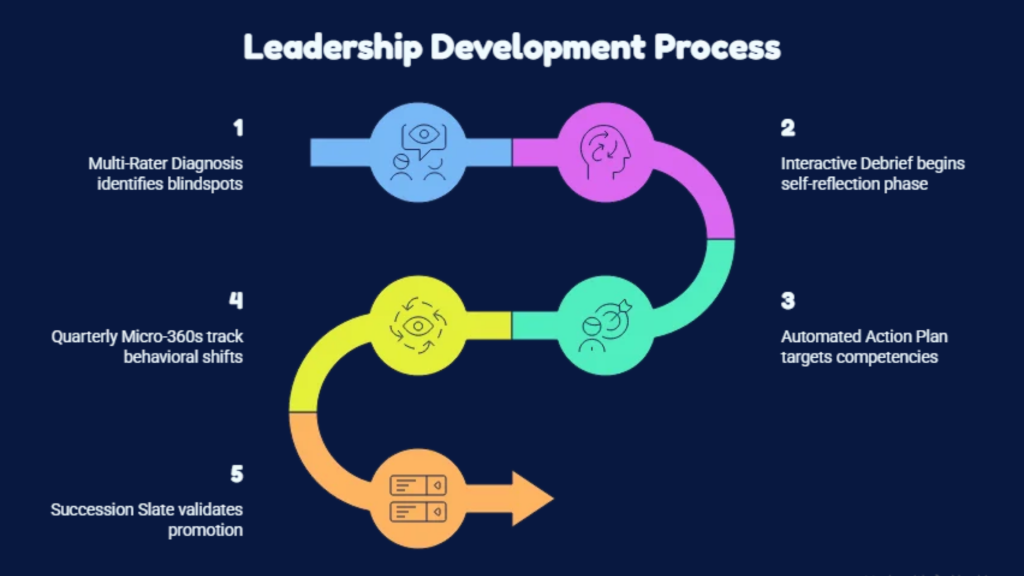
5 Steps to Connect Development and Succession Using the Blindspot Blueprint
-
Deploy Objective Multi-Rater Diagnostics
To identify true potential, step away from top-down performance reviews. Deploying a dedicated 360 feedback assessment allows you to gather anonymous, multi-perspective ratings across custom behavior frameworks. Utilizing modern 360 feedback tools ensures that evaluations pull input from peers, direct reports, and managers, providing a broader behavioral baseline for each succession candidate.
For reliable results, organizations should use consistent assessment criteria, protect respondent confidentiality, and evaluate feedback alongside other evidence of leadership readiness.
- Map Multi-Perspective Data to Leadership Competencies
A robust leadership competency assessment should evaluate specific, observable behaviors rather than abstract traits
Look at core competency clusters like strategic vision, team empowerment, adaptability, and operational execution. Comparing self-ratings against feedback from other raters exposes specific behavioral friction points that require attention.
For example, a successor candidate with strong operational execution but weaker delegation skills may need targeted coaching before assuming responsibility for multiple departments. This allows HR teams to prioritize competencies based on the requirements of each future leadership role rather than relying on generic development programs.
- Transition from Feedback to Interactive Self-Reflection
Traditional 360 reviews often fail because participants receive static PDF reports that trigger defensiveness or get filed away and forgotten. Modern leadership 360 software can support more interactive, private, and self-paced debrief experiences. Using platforms like MyMentor Interact, candidates navigate their data section-by-section, answering guided prompts that encourage deep self-reflection on why their ratings differ from team feedback.
This reflection process helps candidates understand how their behaviors affect others and identify specific changes they can make to improve leadership effectiveness.
- Turn Identified Blind Spots into an Automated Leadership Development Plan
An AI-supported leadership assessment tool, such as MyMentor Develop, can help translate reflection insights into structured development activities and measurable 90-day goals. Instead of generic training, candidates receive a personalized leadership development plan tailored specifically to closing their highest-priority blind spots.
Each development goal should include a clearly defined behavior, practical action steps, a measurable success indicator, and a target completion date.
- Validate Succession Readiness with Continuous Micro-Tracking
Succession planning requires objective evidence of growth before a promotion occurs. By running quarterly mini-360 pulse surveys, HR leaders can track whether a candidate’s targeted behavioral changes are being noticed by their direct reports and peers over time.
This continuous 360 performance feedback loop provides useful evidence for succession decisions while allowing HR leaders to adjust development plans when progress falls short of expectations.
Combining feedback trends with performance results, role-specific assessments, and coaching observations creates a more balanced picture of executive readiness.
Comparison: Traditional Succession vs. The Blindspot Blueprint Approach
| Focus Area | Traditional Succession Planning | The Blindspot Blueprint Approach |
| Data Source | Top-down manager opinion & annual reviews | Comprehensive multi-rater feedback |
| Evaluation Method | Static 9-box grids & subjective ratings | Dynamic manager effectiveness survey data |
| Debrief Experience | One-off meeting or emailed PDF report | Private, AI-guided interactive reflection |
| Action Planning | Manual, disconnected development goals | Automated, behavior-anchored growth plans |
| Progress Validation | Annual performance review check-ins | Continuous quarterly pulse metrics |
| Succession Readiness | Primarily based on previous performance and leadership recommendations | Evaluated using demonstrated growth, role-specific competencies, and multiple sources of evidence |
De-Risking Your Executive Pipeline for the Long Term
When you integrate development planning with succession pipelines, you reduce uncertainty and improve the quality of executive talent decisions. Promotable leaders receive the continuous coaching and behavioral clarity they need to succeed long before they step into higher positions. Organizations can strengthen this process by combining 360 diagnostics, self-guided reflection, personalized leadership training, and quarterly progress dashboards. Rather than treating succession planning as an annual administrative exercise, HR teams can establish an ongoing system that connects leadership potential with demonstrated readiness.
Explore MyMentor Insights to learn how 360 feedback and structured leadership development can support a stronger succession pipeline.
Conclusion
Connecting your leadership development plan strategy with succession planning helps create a leadership pipeline grounded in behavioral evidence, self-awareness, and continuous development.
By utilizing the Blindspot Blueprint, HR leaders can move beyond subjective ratings and build clear, scalable development pathways that prepare tomorrow’s executives today.
With structured multi-rater feedback, personalized action planning, and ongoing progress tracking, organizations can make more informed succession decisions while helping future leaders develop the competencies their roles demand.
Ready to strengthen your succession pipeline? Discover how MyMentor Insights brings together 360 feedback, interactive debriefs, and AI-supported development planning to turn leadership blind spots into meaningful growth opportunities.
Frequently Asked Questions (FAQs)
1 Q: How often should succession-focused 360 feedback surveys be conducted?
A full multi-rater assessment may be conducted annually, while targeted micro-360 pulse surveys can be scheduled quarterly when appropriate. These smaller checks measure specific behavioral adjustments without causing unnecessary survey fatigue.
2 Q: What is the best way to handle defensive reactions to blindspot feedback?
Defensiveness can occur when feedback is delivered without sufficient context or support. Providing private, self-paced digital debrief experiences alongside constructive coaching allows leaders to process multi-rater results independently, reflect on the findings, and identify practical improvement opportunities.
3 Q: Can AI replace human executive coaches in leadership development?
AI coaching and automated action planning do not replace strategic human guidance; rather, they can help scale personalized development support. AI tools may assist with goal setting, reflection prompts, and progress tracking between formal coaching sessions, while human coaches provide contextual judgment and interpersonal support.